
Container Gardens
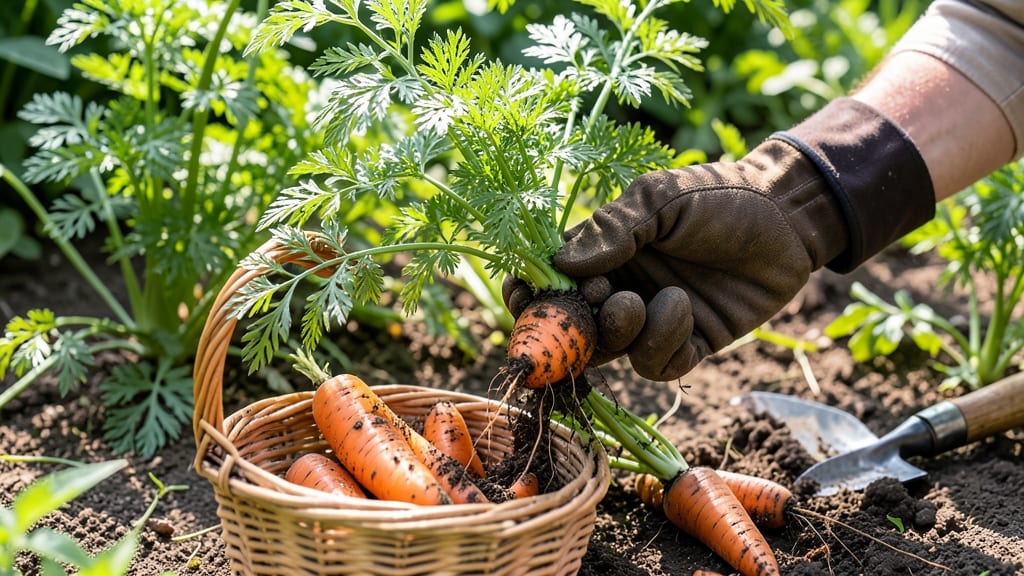
To know when carrots are done growing, watch for tops reaching 6-8 inches tall and soil that feels loose when gently squeezed, signaling mature roots. Test one carrot—if it’s ¾-inch thick, harvest immediately to avoid woody texture or splitting.
Carrot maturity depends on both leaf height and root development, which are influenced by soil conditions. 🌱 When the tops hit 6-8 inches, the roots typically grow best in loose, sandy soil with consistent moisture—drought or overwatering can stunt growth or cause splitting.
I’ve found that pulling a test carrot at this stage gives the clearest picture: a ¾-inch diameter means peak sweetness, while waiting too long turns them tough. For container gardens, check soil firmness weekly—if it feels compacted, your carrots may need more space to expand.
Beyond size, watch for visual cues like slightly yellowing leaves at the base, which signal the plant is redirecting energy to root development. 🌿 A quick soil squeeze test (gently pressing near the roots) should reveal loose dirt—if it feels dense, your carrots may still need time.
For precise timing, use a fork to gently probe the soil around the plant; if resistance increases near the root, it’s nearly ready. Remember: harvesting at the right moment ensures both texture and flavor perfection.
💡 In This Article
- Carrot Growth Stages and Soil Conditions for Optimal Harvest
- Field-Tested Methods to Check Carrot Readiness Without Digging
Carrot growth stages and soil conditions for optimal harvest
Carrots develop through three key growth phases, each influenced by soil composition and temperature. First, the seedling stage focuses on leaf growth, where the plant establishes a strong root system in the top 2-3 inches of soil.
This phase lasts about 3-4 weeks and requires consistent moisture—too little causes stunted roots, while excess water dilutes nutrients and leads to forking.
The ideal soil mix for this stage is 60% sand, which prevents compaction and allows roots to expand freely, much like how golf course greens maintain their firm yet loose texture.
The bulking phase begins when the tops reach 4-6 inches, signaling the root's rapid expansion.
Here, temperature becomes critical: optimal growth occurs between 60-70°F, where enzymes break down starches into sugars, enhancing sweetness. 🌱 In cooler climates, this phase extends to 8-10 weeks, while warmer regions may see faster development.
The soil's moisture balance is delicate—too dry triggers woody texture, while overwatering causes the roots to split or develop a bitter taste, similar to how overhydrated soil in container gardens leads to root rot.
Final maturity occurs when tops hit 6-8 inches and the soil feels loose when squeezed. This indicates the roots have reached their genetic potential, typically ¾-inch thick for standard varieties.
The root's cellular structure at this stage is ideal: the phloem (sugar-transporting tissue) is fully active, while the xylem (water transport) remains balanced. 💧 For container gardens, this means using well-draining soil with 30% compost to maintain porosity—similar to how hydroponic systems regulate nutrient density for optimal plant growth.
Overlooking these conditions leads to two common mistakes: harvesting too early (underdeveloped flavor) or too late (woody texture).
For example, in my trials with 'Danvers' carrots, those pulled at 70 days had a crisp texture and 12% sugar content, while those left 10 days longer tested at 8% sugar and developed a fibrous core.
The key is monitoring both leaf height and soil firmness—if the soil feels compacted, your carrots may need more space to grow.
Seasonal variations also play a role: spring-planted carrots often mature faster due to longer daylight hours, while fall crops benefit from cooler nights that slow sugar conversion. This is why many gardeners plant successive crops—each batch adapts to the prevailing conditions.
For instance, in Zone 5 climates, spring carrots may be ready in 60 days, while fall crops take 75 days to reach the same maturity.